
Manual time tracking is one of the few administrative tasks that almost every knowledge worker, freelancer, and software engineer universally dislikes. Despite dozens of timer apps promising to make logging hours effortless, the core ritual remains painful: pausing before you start a task to punch a virtual clock, remembering to stop it when you switch tabs, and guessing what happened when you inevitably forget.
The problem is not a lack of personal discipline. The problem is that manual time tracking is fundamentally mismatched with how human brains engage in creative, high-focus work.
Here is why manual timers fail, the hidden costs they impose on your day, and what modern automated tracking does instead.
Why Does Manual Time Tracking Feel Like Such a Chore?
Manual time tracking feels painful because it introduces cognitive friction before and after every single task, forcing you to act as an administrator rather than a creator. Instead of seamlessly diving into complex problem solving, you must open an app, select a client, pick a project, type a description, and remember to press start.
When you finish or get interrupted, you must remember to stop the timer. If you switch to answering a client email or checking a quick pull request, the timer either runs silently in the background for hours or you spend mental energy toggling between states.
Manual Timer Loop:
[Start Task] -> [Open App] -> [Select Project] -> [Press Start] -> [Work] -> [Get Interrupted] -> [Forget to Stop] -> [Guess / Fix Later]
This constant mental overhead turns time tracking into a persistent background anxiety. You are no longer just doing your job; you are managing the meta-work of recording that you are doing your job.
How Do Start-Stop Timers Destroy Your Flow State and Deep Work?
Start-stop timers disrupt deep work by introducing "attention residue"—the psychological drag that occurs when your attention is divided between your primary task and an external monitoring duty. Reaching deep focus requires sustained immersion, but a running timer forces part of your brain to remain vigilant about the clock.
Research in cognitive psychology shows that it takes between 15 and 23 minutes to regain deep focus after an interruption. When a timer requires you to pause and re-categorize your activity every time you transition between an IDE, documentation, terminal, or communication tool:
- Micro-interruptions compound: Toggling timers five times an hour fragments your cognitive continuity.
- Friction creates avoidance: Because starting a timer adds friction, you delay starting small but important tasks.
- Fear of running timers: Leaving a timer running on the wrong client creates stress, leading you to constantly monitor the tool instead of your work.
High-value work requires uninterrupted immersion. Any tool that forces you to constantly acknowledge its existence during work actively harms the quality of that work.
Why Are Friday Afternoon Timesheets So Statistically Inaccurate?
Friday afternoon timesheets are notoriously inaccurate because human memory suffers from severe recall decay, leading professionals to reconstruct their week through guesswork, confirmation bias, and rounding errors. Studies show that reconstructing time even 24 hours later results in an error rate of up to 25–40%.
When you sit down at the end of the week to fill out an empty timesheet, you inevitably resort to "calendar fiction":
- You look at your meeting calendar and assume you worked on project tasks in the empty slots between calls.
- You round everything to neat increments (e.g., 2 hours here, 1 hour there), masking the real distribution of your day.
- You underestimate non-linear work, like debugging, research, and design iterations that did not have formal calendar invites.
The result is a sanitized approximation of your week that satisfies an invoicing template but fails to reflect reality.
How Much Money Do Freelancers Lose by Forgetting Micro-Tasks?
Freelancers and agencies lose between 10% and 20% of their total billable revenue every month by failing to capture unrecorded micro-tasks and context switches. When using manual timers, small tasks feel too short to justify starting a new timer, so they go unbilled.
Consider the billable micro-tasks that occur throughout a typical workday:
- A 10-minute client Slack conversation clarifying project specifications.
- An 8-minute urgent code review or hotfix deployment.
- A 12-minute email response providing technical guidance.
- A 15-minute asset export and upload to a staging environment.
| Task Type | Daily Frequency | Average Duration | Weekly Unbilled Time | Annual Lost Revenue ($100/hr) |
|---|---|---|---|---|
| Client Communications | 3x daily | 10 mins | 2.5 hours | $12,500 |
| Quick Revisions / Code Reviews | 2x daily | 15 mins | 2.5 hours | $12,500 |
| Scoping & Clarifications | 1x daily | 20 mins | 1.6 hours | $8,000 |
| Total Estimated Leakage | — | — | ~6.6 hours/week | ~$33,000/year |
Over a month, these unrecorded fragments accumulate into dozens of unbilled hours. Without an automatic record of your actual screen activity, this revenue simply vanishes.
Why Do Traditional Cloud Time Trackers Miss the Mark?
Traditional cloud time trackers miss the mark because they either burden users with bloated web interfaces and high monthly subscription fees, or swing to the opposite extreme by acting as invasive "bossware" surveillance tools.
Most conventional tools suffer from three fundamental design flaws:
- Subscription Bloat: Charging $15 to $30 per user every month for what is essentially a glorified stopwatch.
- Invasive Employee Surveillance: Capturing random desktop screenshots, keystroke rates, and webcam snapshots under the guise of productivity tracking—destroying trust and autonomy.
- Cloud Data Exposure: Streaming every document title, URL, and client file path to remote cloud databases, creating significant compliance and non-disclosure agreement (NDA) risks.
Professionals do not want to be spied on, nor do they want to spend hours filling out cloud forms. They want a quiet, trustworthy tool that captures their day without invading their privacy.
What Is Passive, Local-First Time Tracking and How Does It Work?
Passive, local-first time tracking is an automated workflow where a lightweight background desktop application records your active applications and window titles locally, reconstructs your day into structured timeline blocks, and never transmits your data to external servers.
Instead of demanding your constant attention, passive tracking works silently in the background while you focus entirely on your work.
Passive Local Tracking Flow:
[Open Computer & Work] -> [Background Local Observer Records Windows/Files] -> [Deterministic Rules Group Work into Projects] -> [Review Structured Daily Blocks]
How Does Automatic Window and App Classification Work Under the Hood?
Automatic classification works by matching active window titles, application names, and browser URLs against deterministic keyword rules and project patterns you define.
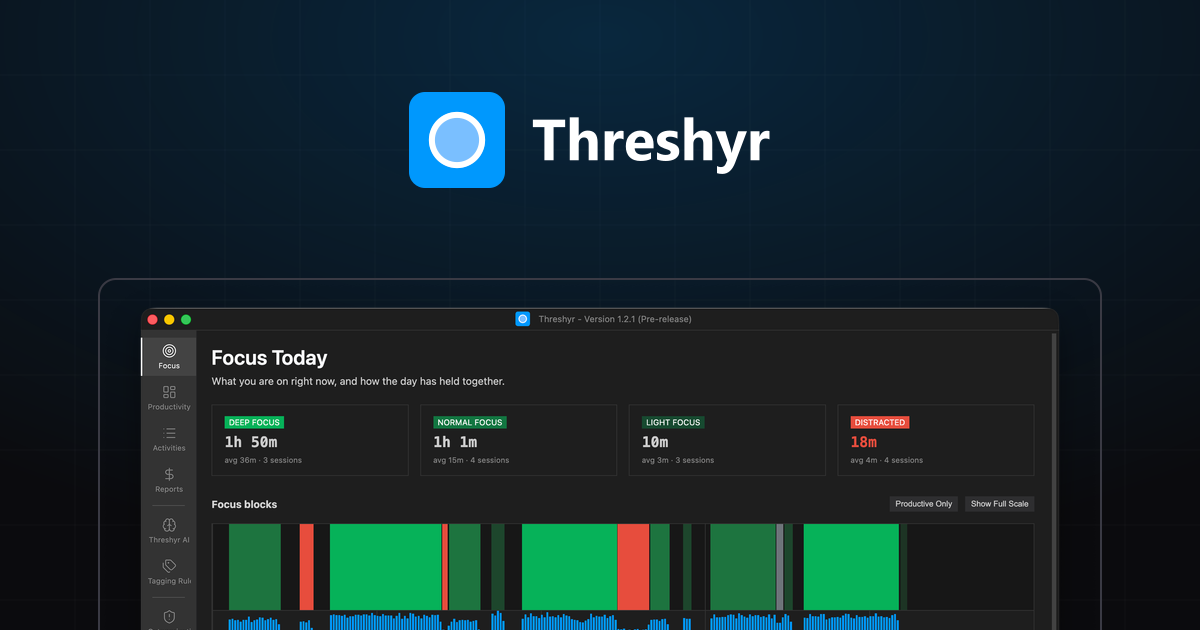
For example, when you switch to VS Code with a folder named client-portal, open Figma with a file named Mobile App Redesign, or review a GitHub pull request for api-backend, the local engine assigns those minutes directly to the corresponding project without requiring you to touch a button.
Rules Example:
- Window Title contains "client-portal" -> Project: Acme Corp ($120/hr)
- App == "Figma" AND Window Title contains "Mobile App" -> Project: Brand Sprint ($95/hr)
- URL contains "github.com/org/repo" -> Project: Core Platform ($150/hr)
At the end of your day, your work is already organized into clear, reviewable blocks of continuous activity.
Why Is Keeping Time Tracking Data on Your Local Machine Essential?
Keeping time tracking data on your local machine is essential because window titles and file paths contain confidential client information, proprietary source code names, and personal browsing activity that should never leave your physical device.
With a local-first tracker like Threshyr:
- Zero Network Uploads: Your timeline database is stored in a local SQLite file on your machine.
- Full NDA & GDPR Compliance: You can track work for sensitive clients (legal, healthcare, finance, proprietary tech) without violating data privacy covenants.
- Offline Independence: Tracking works seamlessly on airplanes, remote locations, or during internet disruptions.
How Do Manual Timers and Automated Tracking Compare Side by Side?
When evaluated across user friction, accuracy, privacy, and cost, automated local tracking fundamentally outperforms manual timer methods:
| Feature / Criteria | Manual Cloud Timers (Toggl, Clockify) | Automated Local Tracker (Threshyr) |
|---|---|---|
| User Interaction Needed | High (must start, stop, and switch manually) | Zero during work (passive background capture) |
| Deep Work Preservation | Poor (constant interruptions & attention residue) | Excellent (runs silently without UI interference) |
| Micro-Task Capture | Misses short calls, emails, and quick PR reviews | Records every minute accurately |
| Data Privacy & Storage | Uploaded to 3rd-party cloud servers | 100% offline, local SQLite database on your device |
| End-of-Week Invoicing | Requires hours of manual timesheet fixing | One-click export directly from classified blocks |
| Pricing Model | $12–$30/month recurring subscription | $29/year flat license, no monthly fees |
How Can You Transition from Manual Timers to an Automatic Workflow?
Transitioning from manual timers to an automated, friction-free tracking workflow takes less than five minutes:
- Install a Local Background Tracker: Download a native desktop tracker such as Threshyr for Windows or macOS.
- Set Up Basic Project Keyword Rules: Map your primary folders, client names, repository stems, and design files to your client accounts (e.g., matching client names in window titles).
- Work Naturally Without Opening Timers: Go through your day focusing entirely on execution without punching in or out.
- Review Your Day in Blocks: At the end of the day or week, open your timeline to review the automatically clustered blocks, adjust any uncategorized time, and export your itemized billable hours.
Ready to Ditch Manual Timers for Good?
Time tracking should serve you, not the other way around. By replacing manual start-stop buttons with passive, privacy-respecting local tracking, you protect your flow state, recover hundreds of unbilled hours, and gain complete clarity over your workday.
Experience automatic, private time tracking on Windows and macOS. Download Threshyr today.

Written by Affan Bajwa
Founder of Threshyr. Passionate about local-first software architecture, developer productivity, and building privacy-first tools for knowledge workers.
Track your time automatically. Without the cloud.
No timers to click. No cloud tracking. Your private window titles and project logs stay on your machine forever.
Available for Windows & macOS • Pre-release at $29/yr
Related Articles
Software Should Be Getting Cheaper. Why Isn't It?
Building software has never been cheaper or faster, yet subscription prices continue to climb. Here is why software pricing broke away from production costs.

Stop Searching: The Last Time Tracker You'll Try
Break the cycle of abandoned timers and inaccurate timesheets with an automatic, local tracker that records your desktop workday without an account.