
If you walk into a medical school library during USMLE Step 1 prep, or a law school reading room six weeks before the Bar Exam, you will observe a familiar sight: an open laptop running Anki or a legal question bank, a heavy reference text propped up on a bookstand, and an iPhone resting immediately beside the keyboard, glowing with a virtual tree growing on a Pomodoro app.
The student reaches out to check how many minutes are left in their study session. While their hand is on the phone, they notice a WhatsApp banner, a group chat notification about a residency program, and a news alert.
They tap the notification "just for twenty seconds."
Twelve minutes later, the virtual tree has withered, the active recall session on renal pathology has derailed, and the student feels a familiar wave of frustration.
High-stakes professional exam prep—whether for the USMLE, the Bar, the MCAT, or the CFA—is not college homework. It is a grueling, 40-to-60-hour weekly marathon of pure cognitive endurance. Treating it with gamified smartphone apps is like trying to train for an Olympic marathon with a fitness watch that buzzes every mile with social media memes.
Here is why serious medical and legal scholars are ditching gamified mobile timers and moving to native, distraction-free desktop tracking.
1. The Phone Proximity Effect: The Cognitive Tax of an iPhone on Your Desk
In 2017, the Journal of the Association for Consumer Research published a landmark study titled "Brain Drain: The Mere Presence of One's Own Smartphone Reduces Available Cognitive Capacity."
The researchers tested hundreds of participants on memory and cognitive focus under three conditions:
- Smartphone placed face-down on the desk.
- Smartphone placed in a pocket or bag.
- Smartphone placed in another room entirely.
The findings were stark: participants with their phones on their desks performed significantly worse on cognitive tests, even when the phone was turned completely on silent, face-down, and powered off.
Why? Because human working memory must expend active sub-conscious effort to inhibit the impulse to check a nearby phone.
When you use a mobile app like Forest, Flora, or a phone-based Pomodoro timer to track study hours, you force yourself to keep the single most addictive device ever invented directly inside your peripheral vision for eight hours a day.
Professional students do not need cute incentives on a phone. They need to put their phones in a drawer in another room and keep their working environment strictly contained on their computer.
2. Gamified Apps Track Activity, Not Subject Mastery
Mobile study timers rely on gamification: growing digital plants, accumulating virtual coins, and maintaining unbroken calendar streaks.
While gamification can motivate a high school student to finish thirty minutes of algebra, it breaks down completely under the demands of professional school:
The Streak Addiction Trap
Gamified apps punish you for taking a necessary rest day. If you complete an intense 50-hour study week before a simulated Bar exam and deliberately take Sunday off to let your brain consolidate memories, a broken streak treats you like a failure.
Lack of Subject Granularity
A mobile app tells you that you studied "6 hours today." But for a medical student, six hours of generic studying is meaningless. You need to know:
- Did you spend 3 hours on Cardiology pharmacology drills, or did you get lost reviewing easy Anatomy flashcards you already know?
- Did your Civil Procedure practice questions receive the dedicated 4-hour block they required, or did Constitutional Law steal the morning?
A timer that does not differentiate between subjects cannot help you identify knowledge deficits.
3. High-Stakes Exam Prep is a Full-Time Professional Job
When you study for the USMLE, the Bar Exam, or the CPA, your daily workflow already lives on your desktop computer:
- Medical Students: UWorld question banks, First Aid PDFs, Anki desktop space repetition, and Sketchy Medical video modules.
- Law Students: Themis or Barbri online portals, Westlaw research, outline documents, and practice multi-state bar exam (MBE) sets.
Having to reach over to a separate physical mobile device to start and stop timers every time you switch between review and practice sets introduces unnecessary friction.
Your tracking tool should live natively inside your primary desktop workspace—quiet, unobtrusive, and designed like an operational instrument rather than a toy.
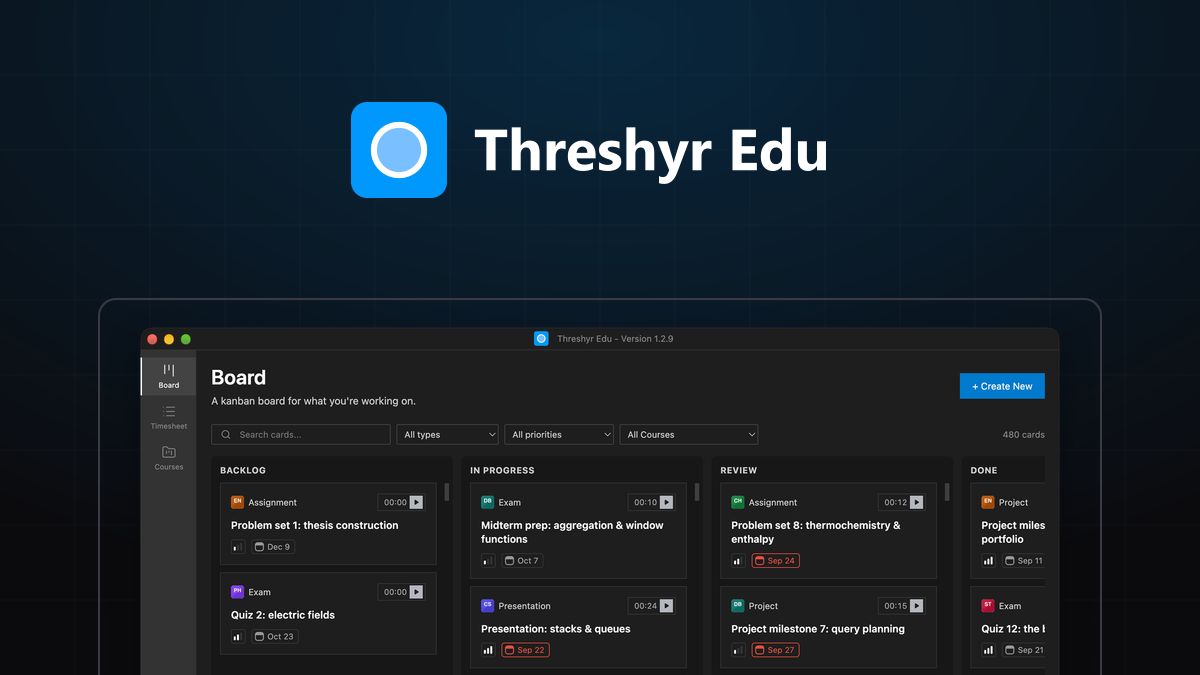
4. Subject-Level Timesheets in Threshyr Edu
We designed Threshyr Edu as a no-nonsense, desktop-native tracker for students who have outgrown phone apps. It is 100% free forever, completely ad-free, requires no account creation, and runs locally on Windows without sending your data to the cloud.
Here is how high-stakes examinees use Threshyr Edu to structure professional study blocks:
┌────────────────────────────────────────────────────────┐
│               Threshyr Edu - Exam Prep                 │
├───────────────────────┬────────────────────────────────┤
│ Subject / Topic       │ Weekly Active Hours Logged     │
├───────────────────────┼────────────────────────────────┤
│ MBE: Civil Procedure  │ 12.5 hrs (Target: 12 hrs)  ✅   │
│ MBE: Torts & Contracts│ 10.0 hrs (Target: 10 hrs)  ✅   │
│ MPT: Practice Essays  │ 6.5 hrs  (Target: 8 hrs)   ⚠️  │
│ Black Letter Law Drill│ 8.0 hrs  (Target: 8 hrs)   ✅   │
└───────────────────────┴────────────────────────────────┘
Treat Each Subject as a Distinct Course
Set up your major exam topics as individual "Courses" in Threshyr Edu (e.g., Pathology, Pharmacology, Microbiology, Biochemistry or Civil Procedure, Torts, Evidence, Constitutional Law).
Tag Intentional Study Modes
When launching a study block, label the task with the exact methodology:
Evidence: 50 MBE Practice Questions (Timed)Pathology: Renal Glomerulonephritis Anki DeckContracts: Issue Spotter Essay 3 Review
Analyze Subject Allocation Every Sunday
Open your Timesheets at the end of the week. Look past the aggregate hour total and examine the subject ratios:
- Are you scoring 54% on Property practice questions while your timesheet shows you only gave Property three hours this week?
- The diagnosis is immediate and unemotional: you are neglecting your weakest subject because it feels uncomfortable. Adjust your next week's schedule accordingly.
Eliminate the Distractions, Protect Your Focus
Passing a licensing board or qualifying examination is about deliberate, focused hours. You do not need virtual forest trees, daily streak guilt, or a glowing smartphone sitting beside your keyboard waiting to derail your concentration.
Leave your phone in your backpack. Keep your study tracking on your desktop where the real work happens.
Download Threshyr Edu for Windows completely free from the Microsoft Store—zero subscriptions, zero cloud telemetry, and total focus.

Written by Affan Bajwa
Founder of Threshyr. Passionate about local-first software architecture, developer productivity, and building privacy-first tools for knowledge workers.
Track your time automatically. Without the cloud.
No timers to click. No cloud tracking. Your private window titles and project logs stay on your machine forever.
Available for Windows & macOS • Pre-release at $29/yr
Related Articles
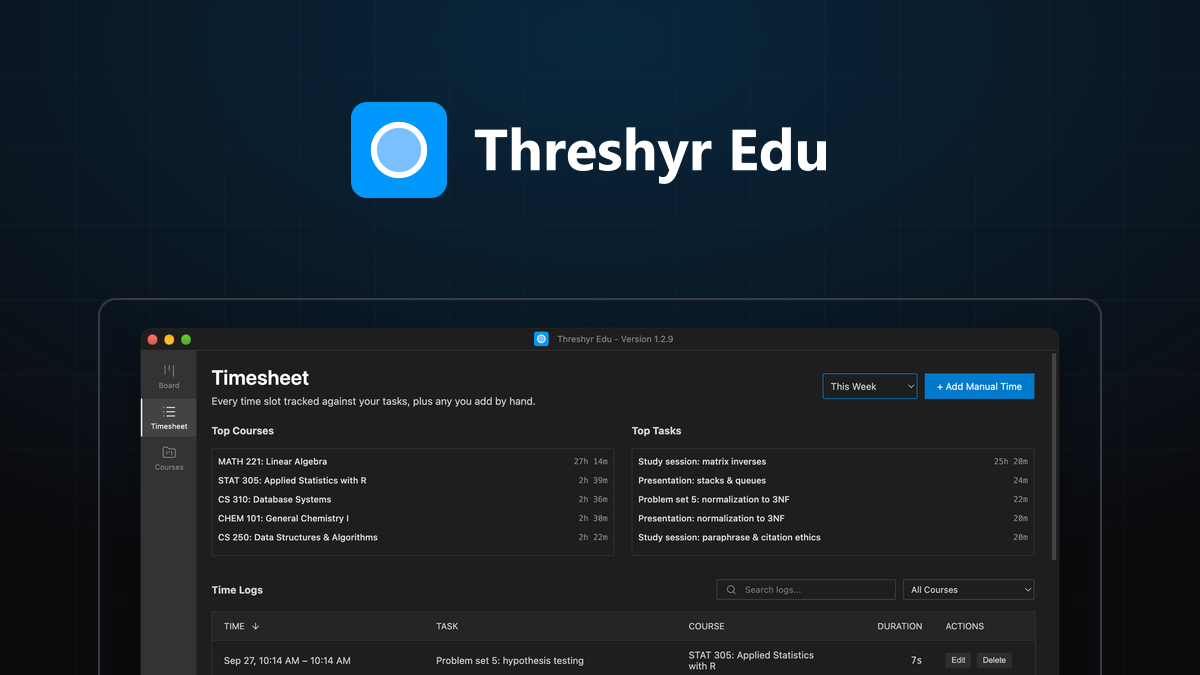
Credit Hours vs Reality: Auditing How Much Time Your Degree Actually Takes
Universities claim that every credit hour requires 2–3 hours of outside study. Here is how to audit your real coursework hours using Threshyr Edu timesheets.

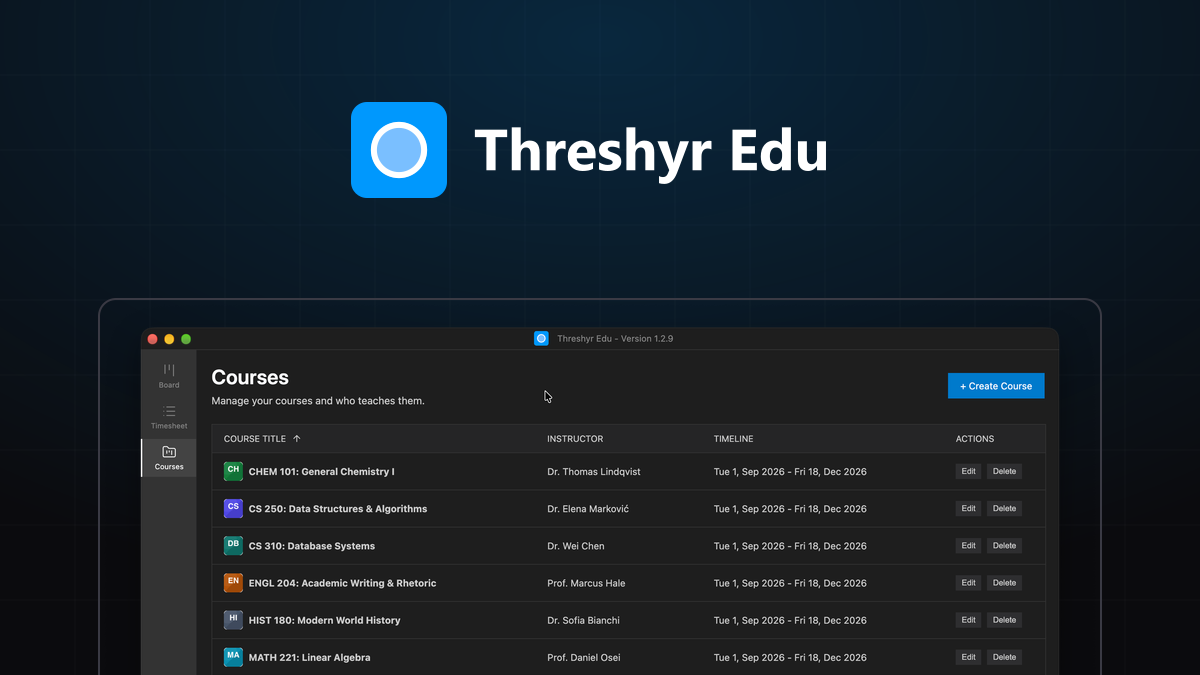
How to Track Thesis and PhD Research Hours Without Cloud Distractions
A structured guide for graduate students and researchers to track literature reviews, lab work, and dissertation drafting using private local timesheets.