
Every freshman orientation features an academic advisor standing in front of a lecture hall explaining the golden mathematical formula of higher education:
"For every one credit hour you take, you must budget two to three hours of outside study time each week."
You run the numbers on your calculator: you enrolled in 15 credit hours, which translates to 15 hours in lecture plus 30 to 45 hours of outside reading, homework, and lab prep. Total weekly commitment: 45 to 60 hours.
It sounds orderly, predictable, and fair.
Then the semester begins. Within four weeks, you discover what every upperclassman already knows: the official university credit hour formula is a statistical fiction.
Where the Credit Hour Formula Breaks Down
The credit hour system—rooted in the early 20th-century Carnegie Unit—was created to standardize faculty pension eligibility, not to measure real human cognitive workload in modern academic disciplines.
In reality, academic departments assign credit values based on degree requirements and budget allocations rather than actual hours demanded from students:
1. The 1-Credit Lab Trap
A university chemistry or biology lab is routinely designated as a single credit hour. Yet that single credit demands:
- 3 hours in the physical laboratory each week
- 2 hours preparing pre-lab calculations and safety protocols
- 4 to 6 hours writing formal lab reports with error propagation data
A "1-credit" course can quietly consume 10 to 12 actual hours per week—a ratio of 10:1 instead of 3:1.
2. The Studio & Project Tax
Architecture studios, fine art workshops, and software engineering capstone courses are notorious for nominal credit values. A four-credit design studio frequently requires twenty to thirty hours of studio fabrication every single week to receive a passing critique.
3. The Light-Lecture Anomaly
Conversely, certain three-credit introductory survey lectures (such as Film History or Introduction to Sociology) might only require ninety minutes of weekly reading and review to maintain a solid grade—a ratio of barely 0.5:1.
When you register for five courses based solely on nominal credit numbers, you are essentially gambling with your schedule. If you accidentally combine three "under-credited time sinks" in the same semester, you face an unsustainable 70-hour workload that leads straight to burnout, dropped classes, or damaged GPAs.
The only way to protect your sanity is to run a coursework time audit.
How to Run a 4-Week Coursework Time Audit
A coursework audit replaces institutional guesswork with hard, objective data. By tracking your real hours across a four-week period, you discover the true "time multiplier" of your courses.
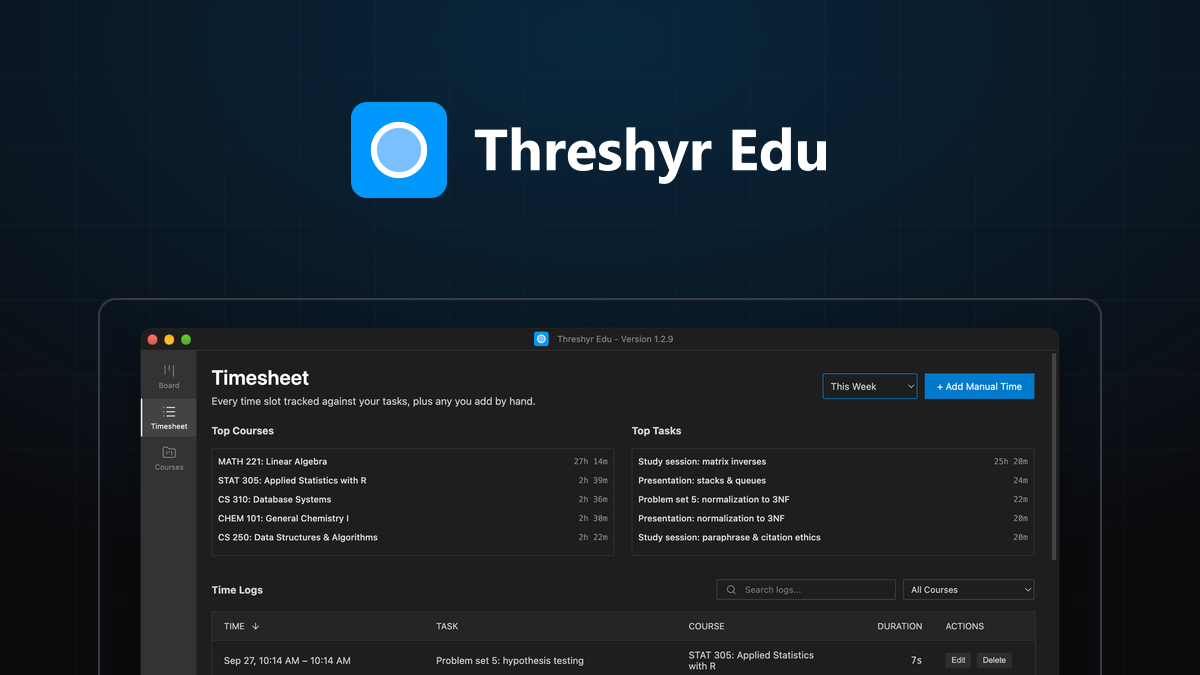
Here is the step-by-step audit method using Threshyr Edu—our free, local desktop time tracker built specifically for students:
┌────────────────────────────────────────────────────────┐
│               The Course Multiplier Audit              │
├──────────────┬─────────┬──────────────┬────────────────┤
│ Course Name  │ Credits │ Logged Study │ Multiplier     │
├──────────────┼─────────┼──────────────┼────────────────┤
│ BIO 201 Lab  │ 1 cr    │ 9.5 hrs/wk   │ 9.5x (Anomaly) │
│ CS 280 (DSA) │ 4 cr    │ 14.0 hrs/wk  │ 3.5x (Heavy)   │
│ STATS 250    │ 3 cr    │ 6.0 hrs/wk   │ 2.0x (Normal)  │
│ PSYCH 101    │ 3 cr    │ 2.0 hrs/wk   │ 0.7x (Light)   │
└──────────────┴─────────┴──────────────┴────────────────┘
Step 1: Set Up Your Classes in Threshyr Edu
Download Threshyr Edu from the Microsoft Store (it is 100% free forever with no ads or account creation). Create a separate "Course" entry for every class and lab on your syllabus.
Step 2: Track Unbroken Sessions Honestly
Whenever you open your textbook, review lecture notes, or write code, click start on that course.
Crucial rule: Pause the timer when you get up for coffee, check your phone, or chat with a roommate. You are not measuring "time spent sitting at a desk"; you are auditing actual cognitive engagement.
Step 3: Run the Audit for Weeks 3 Through 6
Avoid auditing week one (syllabus week is unnaturally light) and finals week (which is an outlier crunch). Weeks three through six represent standard academic cruising altitude: regular problem sets, assigned readings, and first-wave midterms.
Step 4: Calculate Your Real Multipliers
At the end of week six, open your Timesheets view in Threshyr Edu. Calculate the average weekly outside hours for each course and divide by its credit count:
$$\text{Course Multiplier} = \frac{\text{Average Weekly Outside Study Hours}}{\text{Nominal Credit Hours}}$$
- 1.0x or lower (Light): The course demands less outside time than advertised.
- 2.0x to 3.0x (Standard): The course aligns with standard university expectations.
- 4.0x or higher (Time Sink): The course is heavily under-credited and demands disproportionate resources.
Making Strategic Decisions from Your Data
Once you have your real course multipliers in front of you, you can make clear, unemotional decisions about your academic career:
Before the Drop/Withdraw Deadline
If your timesheet audit reveals you are logging 62 hours a week and an elective with a 5.0x multiplier is starving your core degree prerequisites, drop the elective before the deadline. Protecting your mental health and foundational grades is worth far more than struggling through an under-credited class.
Bidding and Scheduling Future Semesters
When building your schedule for next semester, do not look at credit hours in isolation. Consult upperclassmen, review course syllabi, and balance the multiplier load:
- Pair one heavy 4.0x multiplier course (like Organic Chemistry or Systems Programming) with two standard 2.0x courses and two light 1.0x electives.
- Never stack three courses with 4.0x+ multipliers in the same term unless you are prepared to forfeit all social life, hobbies, and sleep.
Your Time is Too Valuable to Guess
College tuition is expensive, but your time and attention are irreplaceable. Navigating a degree based on nominal credit hours is like budgeting your finances based on a store's advertised discounts rather than your bank account.
Audit your real study hours, understand what your degree actually demands, and take complete control of your academic week.
Download Threshyr Edu for Windows completely free from the Microsoft Store—no fees, no subscriptions, and zero cloud tracking.

Written by Affan Bajwa
Founder of Threshyr. Passionate about local-first software architecture, developer productivity, and building privacy-first tools for knowledge workers.
Track your time automatically. Without the cloud.
No timers to click. No cloud tracking. Your private window titles and project logs stay on your machine forever.
Available for Windows & macOS • Pre-release at $29/yr
Related Articles
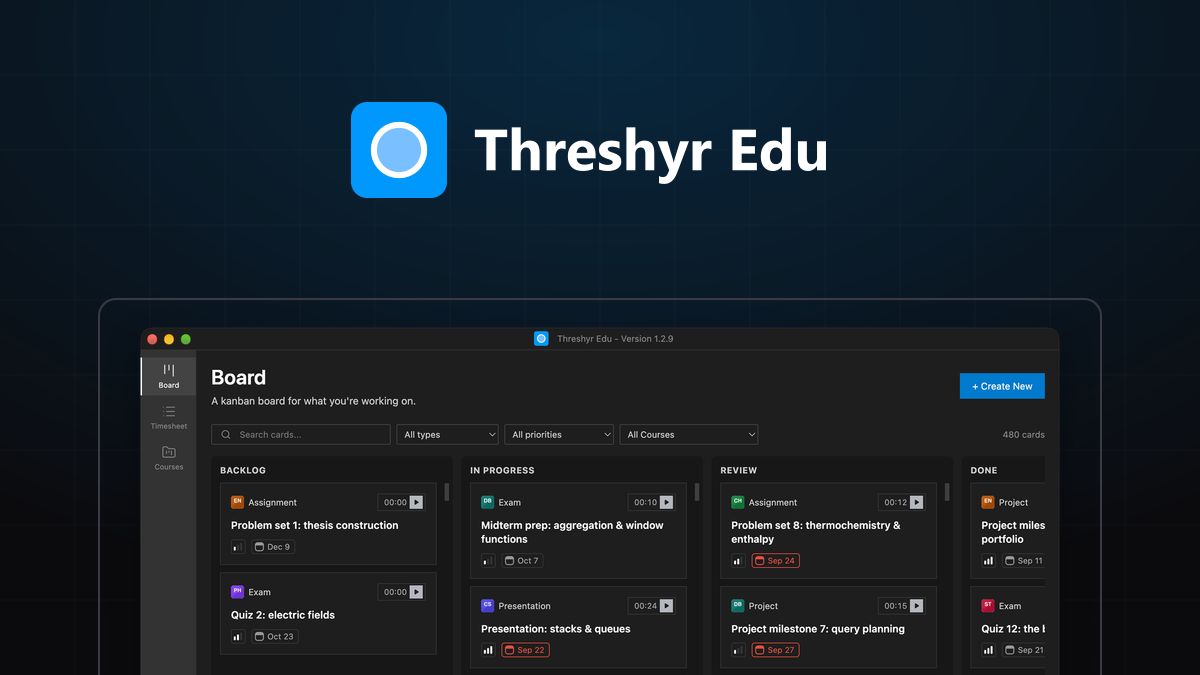
Why Med and Law Students Are Ditching Gamified Phone Timers for Desktop Tracking
Why studying for the USMLE, Bar Exam, or MCAT demands moving away from gamified mobile timers toward distraction-free desktop tracking with Threshyr Edu.

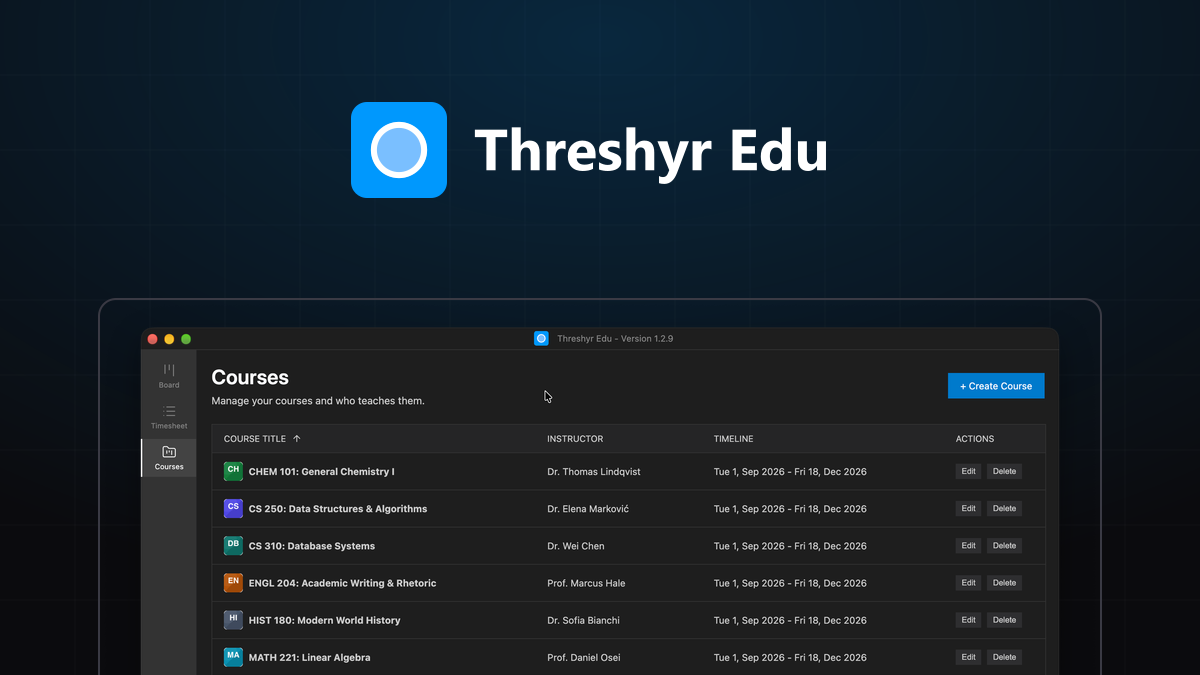
How to Track Thesis and PhD Research Hours Without Cloud Distractions
A structured guide for graduate students and researchers to track literature reviews, lab work, and dissertation drafting using private local timesheets.