
In 2019, a typical subscription for an individual productivity tool or utility cost around $12 per seat per month. In 2026, that same category of software costs $12, $15, or $18 per seat per month. Over that exact same stretch of time, the effort, time, and mechanical complexity required to construct, test, and distribute software fell more rapidly than at any point in the history of computing.
On a Monday morning in July, an automatic renewal receipt arrived in my inbox for a single-purpose utility I had used for four years. The annual charge had quietly climbed by fifteen percent. When I opened the application's changelog to see what justified the increase, the previous twelve months listed three minor interface adjustments, a revised cookie consent banner, and two operating system compatibility patches. The software had not expanded its capabilities, and hosting the application had not become more demanding for the company that built it. The price increased simply because the renewal date arrived and the vendor knew most people would not bother to cancel.
Why Has Hardware Plummeted in Cost While Software Keeps Getting More Expensive?
The standard economic trajectory of technology is deflationary. Across almost every hardware, infrastructure, and manufacturing sector, when the underlying cost of production collapses, consumer prices fall along with it.
Consider the history of raw compute, physical storage, and bandwidth. Decades ago, storing a single gigabyte of data or provisioning a rack of physical servers demanded significant capital expenditure. As fabrication techniques improved and network infrastructure expanded, the cost per gigabyte and the cost per compute cycle fell along steep, predictable curves. High-capacity storage drives and high-speed data transit became dramatically more affordable over time. Competition forced hardware suppliers and infrastructure providers to pass those operational efficiencies directly to the customer, because any vendor attempting to hold prices artificially high was quickly replaced by a competitor with equivalent hardware.
Software was supposed to obey that same dynamic. Once a digital application is compiled, the marginal cost of distributing an additional copy is effectively zero. Delivering updates across modern content networks costs fractions of a cent. Constructing user interfaces, managing data stores, and implementing standard application logic now takes a fraction of the time it required a decade ago. Yet retail software pricing broke away from this historical pattern. Instead of falling as production costs plummeted, software subscriptions remained rigid or drifted steadily upward.
Why Is Commercial Software Decoupled from the True Cost of Building It?
The explanation for this divergence is straightforward: software has never been sold on a cost-plus pricing model.
In physical manufacturing, the cost of raw materials, assembly lines, freight logistics, and shelf space establishes a concrete floor. A physical manufacturer cannot sell below that floor without taking an immediate loss on every unit shipped. Software has no such floor. A digital product is priced almost exclusively on value capture and market tolerance. A tool that saves a business twenty hours of manual labour each month is priced against the monetary value of those twenty hours, completely decoupled from the developer hours required to build the interface.
Because software pricing is severed from production costs, cheaper production methods do not create cheaper software for the buyer. If modern tools cut the engineering time required to build an application by half, the vendor has no structural incentive to lower their subscription fee by half. Instead, the vendor keeps their prices constant and absorbs the difference as profit.
The seat-based subscription model compounds this extraction. When a vendor charges $15 per seat per month, the total bill expands in direct proportion to your team's headcount. If your team expands from five people to twenty, your annual software expense increases from $900 to $3,600. Yet the vendor's marginal cost to serve fifteen additional users on an established database architecture is negligible. The customer pays an escalating premium for the growth of their own business, while the vendor's underlying service delivery cost remains virtually unchanged.
How Do Artificial Switching Costs and Lock-In Protect Inflated Software Margins?
In an open and frictionless market, inflated profit margins attract direct competitors who offer identical utility for lower prices, eventually forcing the market price down toward actual cost. In the software industry, this corrective force is neutralized by switching costs and data lock-in.
Once an application houses years of your operational history, customized project structures, client definitions, and muscle memory, walking away from that software becomes painful and expensive. Migrating to an alternative requires exporting incomplete archives, reconfiguring workflow rules, retraining staff on unfamiliar interfaces, and absorbing lost billable hours during the transition.
When a software vendor introduces a price hike of three dollars per user per month, paying the extra thirty-six dollars a year is almost always more convenient than spending twenty hours manually migrating historical records to a rival platform. As I discussed in Stop Searching: The Last Time Tracker You'll Try, the sheer friction of switching platforms traps individuals and teams in recurring subscriptions for tools they actively dislike.
Lock-in insulates software vendors from normal competitive pressure. It ensures that whenever modern engineering methods make building software faster and cheaper, the resulting surplus remains on the vendor's balance sheet rather than returning to the people paying the invoices.
What Is the Most Valid Counterargument for High SaaS Subscription Prices?
There is a serious counterargument to this perspective, and it deserves to be stated in its strongest form.
Writing code has never been the dominant long-term expense for an established software business. Initial development is a small fraction of the total cost required to run a sustainable software company over five or ten years. The overwhelming majority of an ongoing budget goes toward operations that have not become significantly cheaper: round-the-clock customer support staff, dedicated security audits, SOC 2 compliance certifications, legal retainers, payment gateway overhead, and enterprise sales teams managing multi-month procurement cycles.
Furthermore, cloud infrastructure must be actively monitored and maintained. High-availability clusters, multi-region redundancy, real-time database backups, and incident response teams require continuous capital. A company charging $18 per user per month is frequently paying for an entire operational infrastructure designed to guarantee enterprise uptime and regulatory compliance, not merely funding an engineer's salary.
Beyond operational costs, businesses are not philanthropic institutions. A company is under no economic obligation to discount its product simply because internal development became more efficient. If buyers willingly pay existing rates and derive real utility from the software, charging what the market will bear is normal commercial behaviour.
All of that is valid. But it applies almost entirely to complex, multi-tenant enterprise platforms.
The defense collapses when applied to standalone desktop utilities, single-user tools, and local productivity software. When an application runs on an individual's personal machine, requires no centralized server cluster to process private records, and maintains no multi-user cloud infrastructure, the vendor carries no massive operational apparatus. For a single-user utility, maintaining high subscription prices while production costs decline is a deliberate commercial choice, not the inevitable result of operational overhead.
What Does Passing Infrastructure Savings Back to Customers Actually Look Like?
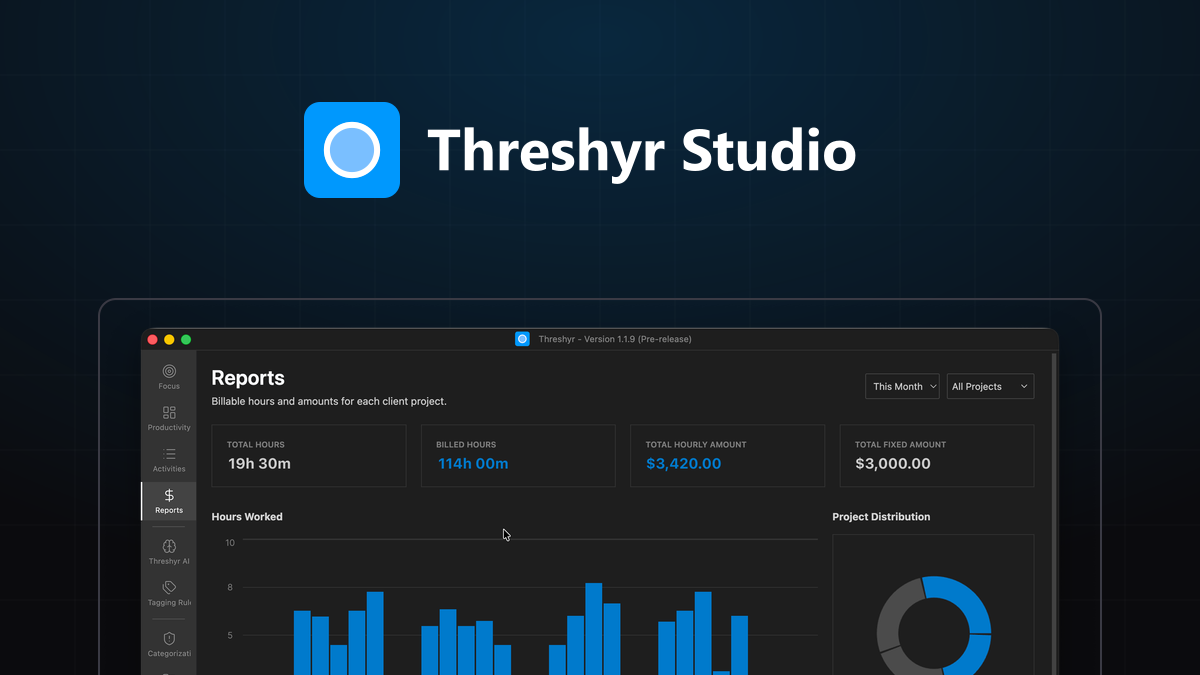
I have an obvious commercial interest in this topic. I built and sell Threshyr, a desktop time tracker for Windows and macOS priced at $29 per year during pre-release. It would be disingenuous not to acknowledge that arguing for lower software prices directly aligns with how I position my own work.
The reason Threshyr can be priced this way, however, is architectural rather than promotional.
When a product is designed to operate locally on the user's hardware, the structural costs that justify traditional monthly SaaS fees disappear entirely:
- On-device processing: Threshyr AI runs locally on your machine and categorizes your activity offline. Because all classification happens on your own hardware, there are no third-party API bills or per-token inference costs to mark up with an extra margin.
- Zero remote server hosting: Your application history, project tags, and client billing rates remain on your local drive. There are no remote database servers to maintain, no cloud storage fees to pass on, and no hosting bills attached to your usage.
- Single yearly licensing: A flat yearly fee covers every feature without monthly billing cycles, seat minimums, credit allowances, or usage tiers.
When evaluating The Best Time Trackers in 2026, Compared Honestly, traditional cloud-based trackers charging $12 to $24 every month quietly accumulate to between $432 and $864 over three years for a single user. When the ongoing cost to run that software on an individual seat is essentially zero, passing those structural savings back to the user is the only honest way to build a business.
Where Does the "Cheaper Software" Argument Stop and Quality Begin?
This essay is not an argument that all software should be cheap or that paying for software is unreasonable.
High-quality software requires years of technical discipline, thoughtful interaction design, and steady maintenance. Platforms that coordinate distributed teams across time zones, facilitate real-time collaborative editing, manage mission-critical accounting ledgers, or offer immediate enterprise support carry substantial ongoing obligations. Those tools deserve their subscription fees because their operational costs are real, continuous, and significant.
The argument here is narrower: pricing should reflect the technical reality of the software you are buying. When a utility operates locally on your desktop, incurs zero hosting cost per active user, and requires no ongoing cloud computation to process your workday, charging perpetual monthly subscription fees is an artifact of industry habit.
As software continues to become faster and cheaper to build, the tools worth keeping will be the ones whose architecture allows those savings to reach your wallet.
Download Threshyr for Windows and macOS at /download. Track your work automatically with complete local privacy and on-device AI for $29 per year during pre-release.

Written by Affan Bajwa
Founder of Threshyr. Passionate about local-first software architecture, developer productivity, and building privacy-first tools for knowledge workers.
Download Threshyr Studio
Free to use during pre-release on Windows and macOS. No account, no card, no sign-up required.
Related Articles

Does Time Tracking and Kanban Really Need to Be Two Separate Apps?
Why do we pay two SaaS subscriptions to manage tasks in Trello and track hours in Toggl? Compare the dual-tool stack with a unified, offline Kanban workflow.

Why We Stop Updating Kanban Boards (And How Fused Time Tracking Fixes It)
Why do Trello and Jira boards decay into graveyards of stale tickets? Explore the two-app friction tax and how fusing time tracking keeps boards alive.